
By Frans de Rond, Senior Recording Engineer at Sound Liaison
Whenever I start a new recording session, I am always a little nervous.
Can I create an atmosphere in which the musicians feel comfortable enough to perform at their very best? Will we make a recording that everyone involved will look back on with pleasure? And can I create a sound that both the musicians and we at Sound Liaison believe in?
For me, these questions are far more important than which microphone or preamp I am going to use.
A recording starts with communication. Before a session, I want to know what the musicians are planning to record, what repertoire they have chosen, and what they want to express through the music. But I also want to get to know the musicians themselves. What kind of music do they listen to? What sort of sound do they like? What do they expect from a recording?
By the time we enter the studio, I usually already have a sound in my head. Not a fixed recipe, but an idea of how I would like the recording to feel. Hopefully, it is a sound that represents the musicians and their music.
And there is another person in the room, even though they are not physically there: the listener at home.
Ultimately, that is who we are making the recording for. We want to bring the performance into your listening room in the most beautiful and inspiring way possible. At that point, it is no longer about microphones, converters, sample rates or cables. It is about emotion.
I see recording technology as a set of tools, a carrier that allows us to transport the emotion of a performance from the studio to your home.
Turning an Idea into Sound
The sound I have in mind determines my choice of microphones and their placement.
No microphone is perfect for everything. You have to get to know a microphone, just as you get to know an instrument. When does it shine? On which instrument? At what distance? In which room?
Do I use an omnidirectional microphone, with its extended low-frequency response and ability to capture the acoustic environment? Or do I choose a cardioid, giving me more directionality, separation and focus?
And what about stereo? An XY pair can give excellent localisation and mono compatibility. Spaced omnis in an AB configuration can create wonderful openness, depth and a sense of space. ORTF, with its combination of level and timing differences, can provide a very natural stereo image.
Or perhaps stereo is not what the instrument needs at all. Sometimes a mono microphone, creating a clear point source within the soundstage, is exactly right.
Then there is distance.
Move a microphone closer and the sound usually becomes more intimate and direct. But you are also listening to a smaller physical part of the instrument. A grand piano, for example, is not one sound source. Different parts of the soundboard and strings radiate different frequencies and harmonics. Close to the instrument, these elements have not yet fully blended acoustically. Moving the microphones further away allows those components to integrate more naturally before reaching the microphones.
But distance also means more room.
And that brings us to one of the most important aspects of recording: every choice is a compromise.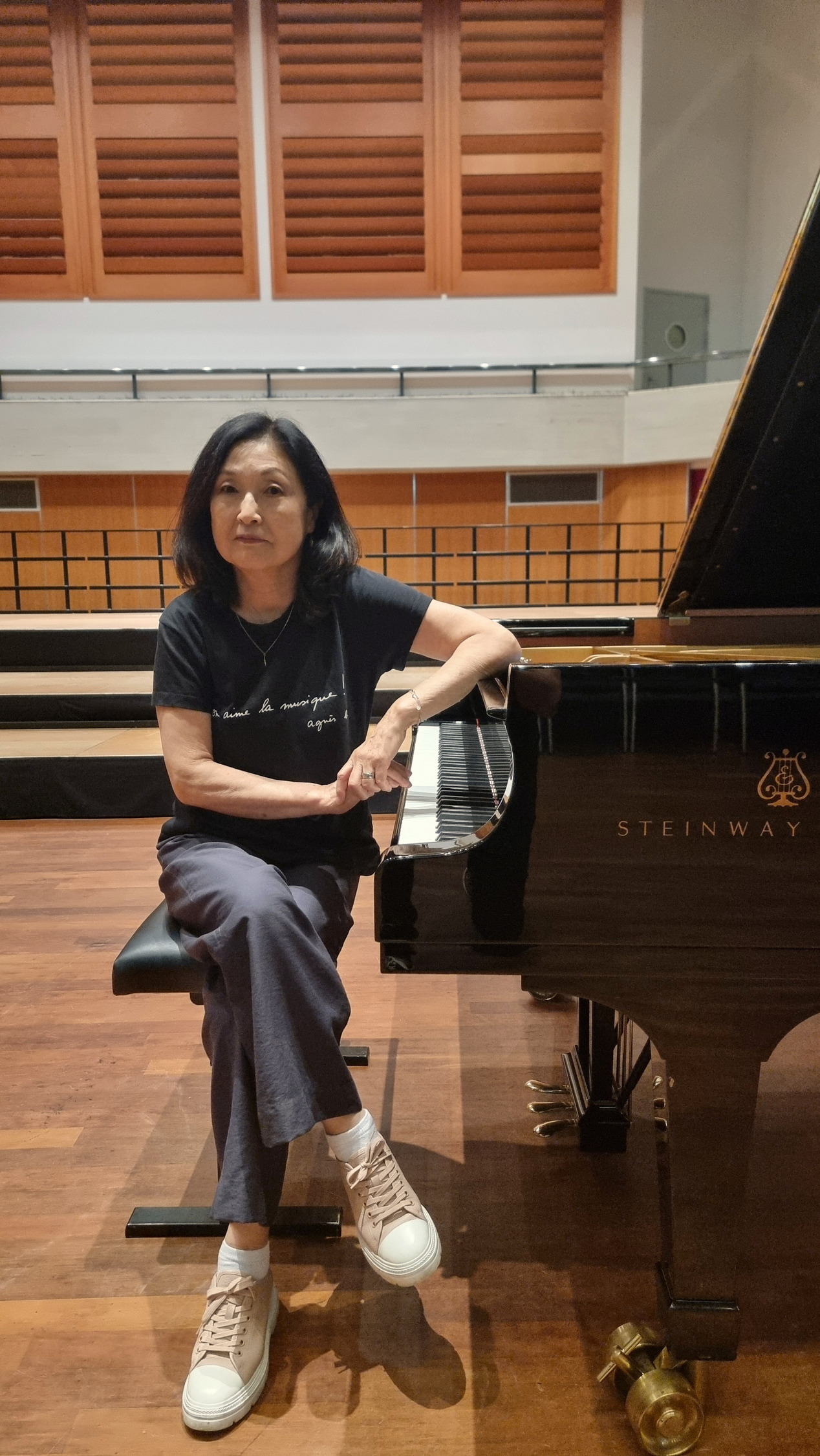
Atzko Kohashi - a Steinway D and Studio 1
Today I recorded pianist Atzko Kohashi in the large Studio 1 at Heuvellaan in Hilversum. It was a solo piano session and a follow-up to her first solo album, Soul Eyes. Atzko was playing the Steinway D concert grand, a magnificent instrument that adds another dimension to the recording. A great piano in a great room sounds wonderful before you have placed a single microphone.
But that does not necessarily make the choices easier.
Studio 1 has a beautiful acoustic, and naturally I want to capture some of that space. The temptation is to move the microphones further into the room and let the hall become part of the sound.
But the more room you introduce, the more you risk losing intimacy.
With Atzko, intimacy is essential. As a listener, I want you to become aware of how she touches the instrument, how a note develops, and how one phrase flows into the next. I want you to feel close enough to follow her musical thoughts as they happen.
And I know Atzko likes that intimacy too.
If I place the microphones too far away and the piano starts to feel distant, I can almost see from her face that I need to make an adjustment.
So we listen. We move the microphones. We listen again.
A little closer.
A slightly different position.
And then, suddenly, we are there.
In the end, my trusted Josephson C700S disappeared under the lid once again. It brought us close enough to the Steinway to create the feeling that you are sitting near the instrument, and, more importantly, near Atzko and her performance.
Of course, I could not resist placing an additional pair of microphones further out in Studio 1. The room is simply too beautiful to ignore completely. Whether I will actually use them is another decision for later.
Perhaps that is the essence of making choices during a recording session.
You need technical knowledge and experience. You need to understand microphones, polar patterns, acoustics and instruments. But then you have to stop thinking about the technology and start listening to what it does to the music.
Less is often more.
And when the sound allows you to forget about the recording and simply listen to the musician, you know you have made the right choice.
Frans